
The Red Eclipse: Decoding the Structural Collapse of the Left in Keralam

Elections in Keralam have long been treated by political scientists as a predictable pendulum. Every five years, power cleanly shifted between the Left Democratic Front (LDF) and the Congress-led United Democratic Front (UDF), a rhythmic exchange that spoke of a highly literate electorate holding its governments on a tight leash. This historical pendulum was deliberately stalled in 2021 when the LDF defied history to win a consecutive second term. But on May 4, 2026, the electorate shattered the red fortress altogether.
The UDF’s staggering haul of 102 seats in the 140-member assembly reduced the CPI(M)-led LDF to a skeletal 35. Thirteen incumbent ministers lost their seats. Chief Minister Pinarayi Vijayan, the undisputed strongman of Keralam politics, resigned hours after retaining his own bastion with a bruised margin.
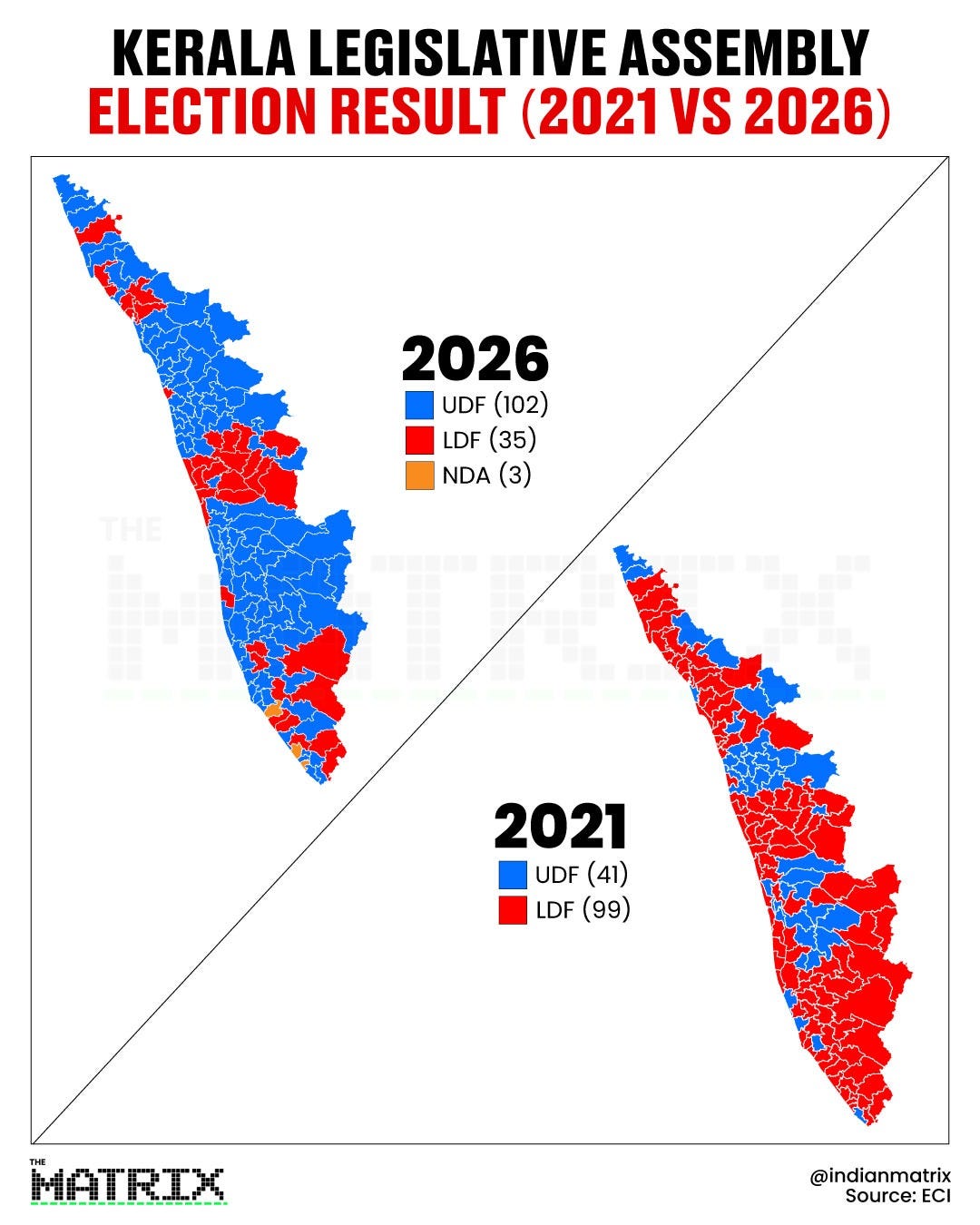
To frame this verdict as mere anti-incumbency is to misread the unique, highly politicised ecosystem of Keralam. For the first time in half a century, there is no communist government in power anywhere in the Indian Republic. The hammer and sickle have been effectively absent from the theatre of state power. Understanding how the Left lost its final citadel requires looking past ideological nostalgia and auditing the cold mechanics of executive arrogance, economic stagnation, and demographic realignment.
Arrogance of the Executive
Elections are rarely lost on spreadsheets alone. They are lost on the streets, driven by the sheer weight of anti-incumbency and executive hubris. If the LDF’s 2021 victory was built on the persona of Pinarayi Vijayan, their 2026 collapse was engineered by it. In 2026, the primary adversary of the Left was not the UDF, but the towering, isolated, and increasingly authoritarian persona of the Chief Minister himself.
During his first term, Vijayan cultivated the aura of a crisis manager, navigating the 2018 floods with paternal authority. But in his second term, that authority curdled into an absolute disconnect. He became notoriously inaccessible, shielding himself behind massive, 40-vehicle security cordons that brought regular traffic to a halt, severely alienating the common citizen.
His public rhetoric grew dismissive. The infamous phrase ‘Kadakku purathu’ (Get out), hurled at the media, became the cultural shorthand for a regime that despised being questioned. But the true breaking point of public patience - the incident that cemented the anti-incumbency wave - occurred during the government’s highly publicised ‘Nava Kerala Sadas‘ mass outreach program.
When opposition youth workers waved black flags at the Chief Minister’s extravagant motorcade, they were brutally beaten by DYFI (CPI-M’s youth wing) cadres and the Chief Minister’s personal security detail. Instead of condemning the violence, Vijayan brazenly justified the brutal assaults on live television, calling them ‘Rakshapravarthanam‘ (life-saving rescue work).
This was a fatal miscalculation. For the ordinary voter, a Chief Minister who rebrands the violent suppression of dissenting youth as rescue work had crossed the line from a strong administrator into an unaccountable autocrat. Former Chief Minister A.K. Antony noted a fascinating phenomenon on the ground: for the first time, hardcore left-leaning voters quietly pressed the button for the Congress. They did not do this out of sudden affection for the UDF, but out of a deep-seated fear that a third consecutive term for Vijayan would end the democratic space in the state altogether.
The Welfare Trap and the Hollow Economy
The gravest error a government can make is breaching its own core social contract. For the LDF, that contract was written in the language of welfarism.
In the fiscal year leading up to the election, the state government defaulted on its social welfare pensions for five agonising months. For 62 lakh beneficiaries, the monthly dole of ₹1,600 was not a luxury; it was the margin of survival. Finance Minister K.N. Balagopal cited severe financial constraints, attempting to shift the blame to New Delhi’s fiscal federalism. But to the pensioner in rural Palakkad or Alappuzha, the macro-economics mattered little. When the government finally released the arrears in instalments just before the polls, it reeked of cynical electoral appeasement rather than a fulfilment of duty.
This fiscal paralysis exposed the foundational lie of the modern “Keralam Model.” The state boasts a 94 per cent literacy rate, yet it has systematically failed to generate capital or industry. According to the Periodic Labour Force Survey (2023–24), Keralam’s youth unemployment rate sits at a staggering 29.9 per cent - nearly triple the national average. For young women, it touches a catastrophic 47.1 per cent.
When an economy produces degrees but no jobs, it exports its youth. Over 2.7 million Keralites have migrated, keeping the state afloat on remittances while the local working-age demographic hollows out. The median age in the state has climbed to 37. The Left promised a ‘Nava Keralam’ (New Keralam), but presided over an ageing state running on borrowed money.
Failure of Optics: The Wayanad Microcosm
If the electorate needed proof of administrative lethargy, the July 2024 Mundakkai-Chooralmala landslides in Wayanad provided a tragic canvas. The disaster, which claimed over 200 lives, demanded rapid state capacity.
The LDF government launched a massive public relations blitz, promising a township of 410 homes for the displaced. Yet, by the time the state went to the polls, a mere 178 houses were complete, and many lacked basic livability. The UDF capitalised on this entirely, with Congress candidate T. Siddique sweeping even traditional Left booths by maintaining a relentless presence on the ground. Wayanad laid bare the defining theme of 2026: a government capable of managing headlines, but incapable of pouring concrete.
Demographic Realignment
The final nail in the LDF’s coffin was the total collapse of its social coalition. Keralam’s electorate is fiercely organised along community lines - Muslims (~26%), Ezhavas (~21.6%), Christians (~18.4%), and Nairs (~15%). The Left managed to alienate almost all of them simultaneously.
Among Hindus, the ideological wounds of Sabarimala had never truly healed. The LDF’s muscular enforcement of the 2018 Supreme Court verdict allowing women into the shrine had deeply alienated the Nair community and traditionalists.
But this ideological injury was fatally compounded by institutional distrust following the Sabarimala gold theft controversy. Audit reports and High Court interventions regarding missing gold and silver offerings from the temple’s strongrooms under the state-controlled Travancore Devaswom Board (TDB) enraged devotees across the state. It solidified a potent, devastating political narrative: that the secular LDF government was simultaneously desecrating Hindu traditions while mismanaging and looting the deity’s wealth. In a desperate tactical retreat just days before the 2026 polls, the LDF government requested to be listed alongside those opposing women’s entry in the Supreme Court review petitions. The U-turn alienated progressive voters while failing to win back the traditionalists, who saw right through the opportunistic timing.
More critically, the Ezhavas - the working-class backbone of the Communist movement- fractured. Battered by the pension delays and jobless growth, a significant chunk of the Ezhava vote drifted. Some returned to the Congress, while others migrated toward the BJP-led NDA, facilitated by the Bharat Dharma Jana Sena (BDJS).
The Christian vote, historically a UDF fortress, had briefly flirted with the Left in 2021. But a bitter, ongoing property dispute between the Orthodox and Jacobite factions over 1,100 parishes left the government paralysed. The LDF failed to resolve the humanitarian crisis of 1.2 million displaced Jacobite believers. Meanwhile, the Catholic laity grew increasingly anxious over what they perceived as the LDF’s minority-appeasement politics, favouring Islamic groups. The UDF read the room perfectly, initiating quiet harmony meetings with church heads and bringing the flock back to the centre.
Finally, the Muslim electorate, sensing the vulnerability of the Left and driven by a tactical desire to consolidate behind the strongest secular shield against the BJP, shifted its weight entirely to the UDF.
End of the Road
The 2026 mandate is a brutal, unforgiving audit of the Indian Left. A political movement cannot survive by substituting governance with ideological posturing. The CPI(M) lost Keralam because it believed its own mythology; it assumed that a highly politically conscious electorate would tolerate economic stagnation and executive arrogance in the name of fighting phantom fascists.
The voters of Keralam have delivered a clinical message: they want jobs, not jargon. They want pensions, not press conferences. The red citadel has fallen, not to a right-wing wave, but to the inescapable gravity of its own failures.
Building this Substack slowly, sincerely, and one reader at a time — your subscription would genuinely mean a lot ✨